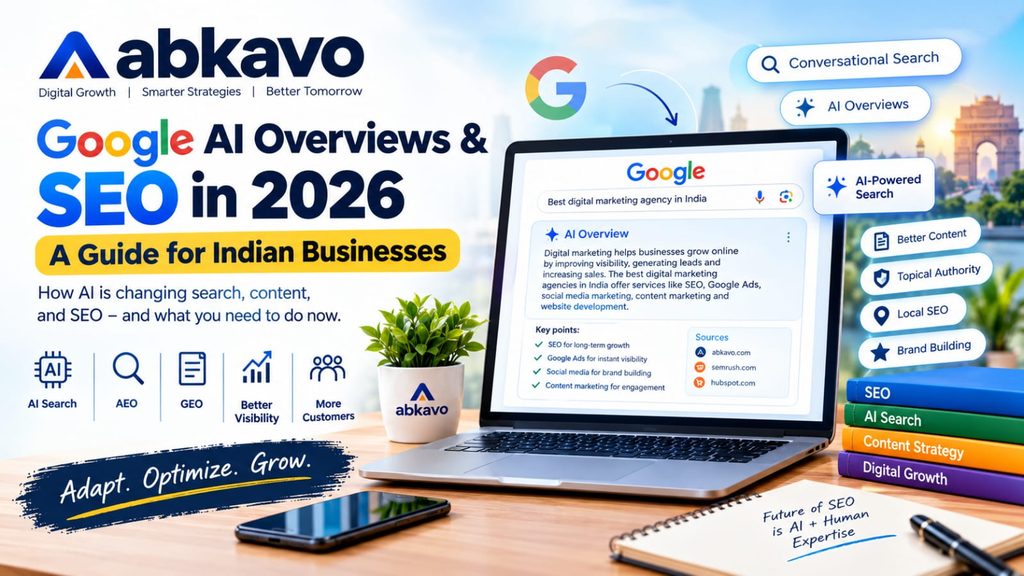
Search is changing.
For years, businesses focused on ranking their websites on the first page of Google. The goal was simple: choose the right keywords, create optimized content, build backlinks, and get users to click on the website.
But in 2026, the search experience is becoming much more conversational and AI-driven.
Google is increasingly using AI to help users understand complex questions and find information faster. At the same time, people are also using AI-powered platforms to research products, services, businesses, and solutions.
This creates a major change for SEO.
Businesses now need to think about more than simply ranking a webpage. They need to become a trusted source of information that search engines and AI systems can understand, evaluate, and potentially reference.
For Indian businesses, this shift creates both challenges and opportunities.
What Are Google AI Overviews?
Google AI Overviews are AI-generated summaries that can appear within Google Search results to help users understand a topic without having to open multiple websites.
Instead of displaying only a list of blue links, search can provide a summarized answer along with supporting sources.
This changes the traditional search journey.
For example, a user searching:
“How can a small business in India generate leads online?”
may receive an AI-generated explanation before clicking on individual websites.
This means businesses need to optimize their content not only for traditional rankings but also for visibility within AI-powered search experiences.
Google has continued expanding AI-powered marketing and search capabilities in 2026, including Gemini-powered tools designed to help businesses reach customers across Search and YouTube.
Why AI Search Matters for SEO
Traditional SEO mainly focused on one important question:
“How do I rank higher on Google?”
AI search introduces another question:
“How do I make my business a useful and trustworthy source for AI-generated answers?”
This is leading marketers to focus on areas such as:
- AI SEO
- Answer Engine Optimization (AEO)
- Generative Engine Optimization (GEO)
- Topical authority
- Brand mentions
- Structured content
- First-hand expertise
- Trust and credibility
Search is becoming more conversational, with AI-generated answers, multimodal search and natural-language interactions changing how people discover information.
- Keyword Stuffing Is Becoming Less Important
In the past, some websites tried to repeat a keyword many times to improve rankings.
For example:
“Digital marketing agency in Delhi”
might be repeated unnaturally throughout an article.
Modern search engines are much better at understanding context.
Instead of writing an article around one keyword repeatedly, businesses should answer the complete topic.
For example, an article about digital marketing agencies could explain:
- What digital marketing is
- Which services businesses need
- How much digital marketing can cost
- How Google Ads work
- How SEO generates traffic
- How social media marketing works
- How businesses can measure ROI
- How to select an agency
This creates a more useful resource.
- Helpful Content Is More Important Than Ever
AI can generate thousands of articles in a short period of time.
That means the internet is becoming crowded with generic content.
Businesses therefore need to provide something AI-generated generic content often lacks:
real experience.
Instead of simply writing:
“SEO helps businesses get more traffic.”
A better article could explain how a business improved its organic traffic, what strategy it used, what challenges it faced, and what results it achieved.
Original research, examples, case studies, expert opinions and first-hand experience can make content more valuable.
In 2026, strong brand positioning and trust are increasingly important as AI makes content production easier. HubSpot’s 2026 marketing research similarly emphasizes the importance of brand point of view, trust and relevance.
- Businesses Need to Build Topical Authority
One article is rarely enough to establish expertise.
Suppose your business provides digital marketing services.
Instead of publishing random articles, create a group of related content.
For example:
SEO
- What Is SEO?
- SEO Guide for Beginners
- Local SEO for Indian Businesses
- Google AI Overviews and SEO
- Technical SEO Checklist
Google Ads
- Google Ads for Beginners
- Google Ads Cost in India
- Google Ads vs SEO
- How to Reduce Google Ads CPC
- AI-Powered Google Ads
Social Media
- Instagram Marketing for Businesses
- Facebook Ads Guide
- Social Media Content Strategy
- Influencer Marketing in India
- AI for Social Media Marketing
This creates a strong topical structure.
When your website consistently covers related subjects with useful information, it becomes easier for users—and potentially search systems—to understand what your website specializes in.
- Write Content Around Questions
AI search is highly conversational.
People increasingly ask complete questions instead of typing only two or three keywords.
For example:
Instead of:
“SEO India”
a user might search:
“How can I get my local business to appear on Google?”
Businesses should therefore create content that answers real customer questions.
Useful formats include:
What is…?
Explain a concept clearly.
How to…?
Provide step-by-step instructions.
Best…?
Compare useful options.
Why…?
Explain causes and solutions.
X vs Y
Help customers make decisions.
How much does…?
Answer pricing and cost-related questions.
This approach can help businesses create content that matches conversational search behavior.
- Local SEO Is Becoming Even More Important
For Indian businesses, local search remains a major opportunity.
A customer may search:
“Best digital marketing agency near me”
or:
“SEO agency in Delhi”
or:
“Best web designer in Noida”
Businesses should make sure their local information is accurate and consistent.
Important elements include:
- Google Business Profile
- Business name
- Address
- Phone number
- Website
- Opening hours
- Customer reviews
- Local landing pages
- Service descriptions
- Location-specific content
For businesses serving multiple Indian cities, dedicated location pages can also be useful when they provide genuinely useful local information.
- Structured Content Helps Search Engines Understand Your Website
Your content should be easy to understand for both humans and machines.
Use:
- Clear headings
- Short paragraphs
- Bullet points
- Tables where appropriate
- FAQs
- Descriptive page titles
- Internal links
- Relevant images
- Proper metadata
- Schema markup where appropriate
For example, instead of writing one huge paragraph about a service, divide it into sections such as:
What is the service?
Who needs it?
How does it work?
What does it cost?
What are the benefits?
Frequently Asked Questions
This makes the page easier to scan and understand.
- Brand Mentions May Become More Valuable
SEO has traditionally focused heavily on backlinks.
Backlinks are still important, but online brand visibility is becoming broader.
A business can build authority through:
- Industry publications
- News websites
- Expert interviews
- Social media
- YouTube
- Podcasts
- Business directories
- Customer reviews
- Community discussions
- Partnerships
The objective should not simply be to obtain links.
The objective should be to build a recognizable and trustworthy brand.
When people repeatedly encounter a brand across different sources, it can strengthen credibility.
- AI Does Not Mean You Should Stop Creating Human Content
One of the biggest mistakes businesses can make is publishing large quantities of generic AI-written articles.
AI is extremely useful for:
- Research assistance
- Content outlines
- Brainstorming
- Editing
- Summarization
- Content repurposing
- Data analysis
- Creative variations
But businesses should still add human judgment.
Before publishing AI-assisted content, check:
Is the information accurate?
Does it provide something useful?
Does it reflect our expertise?
Is it original?
Would a customer trust this article?
Does it answer the user’s actual question?
AI should be treated as a productivity tool—not a replacement for expertise.
- Indian Businesses Have a Big Opportunity
India’s digital audience continues to expand, creating a huge opportunity for businesses that can produce useful online content.
The Digital 2026 global report highlights India’s rapidly developing digital ecosystem, while industry research continues to show strong growth in digital advertising.
Indian businesses can also benefit from creating content for different languages and audiences.
For example, a business could create:
- English content
- Hindi content
- Regional-language content
- Local city pages
- Video tutorials
- Short-form educational content
- FAQs based on customer questions
This allows brands to reach customers across different parts of India.
- SEO in 2026 Is About Visibility, Not Just Rankings
This may be the biggest change.
In the past, businesses often measured SEO success primarily through keyword rankings.
Today, SEO should be viewed more broadly.
A business should measure:
- Organic traffic
- Leads
- Sales
- Brand searches
- Website engagement
- Conversions
- Search visibility
- Local visibility
- Referral traffic
- Brand mentions
A page ranking at position one is valuable.
But a business that becomes a trusted source across Google, AI search, YouTube, social media and other platforms can build an even stronger digital presence.
How to Prepare Your Website for AI Search
Here is a simple checklist businesses can follow in 2026.
Step 1: Audit your existing content
Remove outdated, inaccurate or low-value information.
Step 2: Answer customer questions
Create content around real questions your customers ask.
Step 3: Build topic clusters
Create multiple useful articles around your core services.
Step 4: Add first-hand expertise
Use examples, case studies, original research and practical experience.
Step 5: Improve website structure
Use clear headings, internal links, FAQs and descriptive titles.
Step 6: Strengthen your brand
Build visibility beyond your own website through legitimate publications, social media, videos and industry communities.
Step 7: Track business results
Don’t focus only on rankings. Measure leads, sales and revenue.
The Future of SEO in India
SEO is not disappearing.
It is evolving.
Search engines are becoming more intelligent, users are asking more conversational questions, and AI is changing how information is discovered.
For businesses, this means the old approach of creating pages only to rank for keywords is becoming less effective.
The future belongs to businesses that can combine:
SEO + AI Search + Quality Content + Brand Authority + Human Expertise
The goal is no longer simply to get a click.
The goal is to become the business that customers—and search systems—trust when they need an answer.
Conclusion
Google AI Overviews and AI-powered search are changing the way people discover information online.
For Indian businesses, this creates a new SEO opportunity.
Businesses that invest in useful content, strong expertise, local visibility, technical SEO, brand authority and customer-focused information can adapt more effectively to the new search environment.
AI may change how search results are presented, but one principle remains the same:
Create something genuinely useful for your audience.
If your website consistently answers customer questions better than competitors, provides trustworthy information and demonstrates real expertise, you will be better prepared for the next generation of search.
The future of SEO isn’t just about ranking on Google. It’s about becoming the answer.
About abkavo
At abkavo, we share practical insights about AI, digital marketing, SEO, websites, social media, online business and emerging technology to help Indian businesses grow in the digital age.How Google AI Overviews Are Changing SEO in 2026: A Guide for Indian Businesses
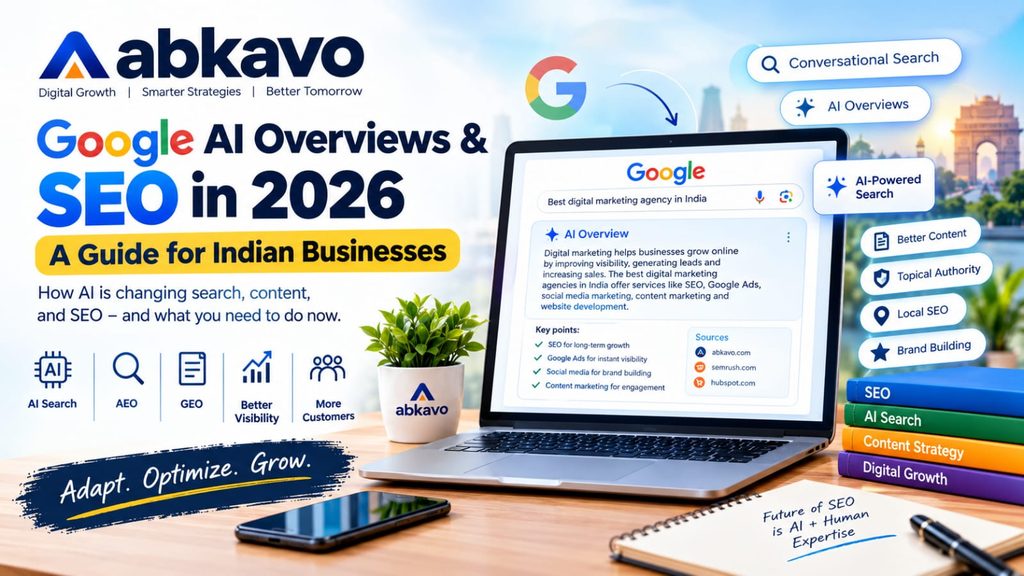
Search is changing.
For years, businesses focused on ranking their websites on the first page of Google. The goal was simple: choose the right keywords, create optimized content, build backlinks, and get users to click on the website.
But in 2026, the search experience is becoming much more conversational and AI-driven.
Google is increasingly using AI to help users understand complex questions and find information faster. At the same time, people are also using AI-powered platforms to research products, services, businesses, and solutions.
This creates a major change for SEO.
Businesses now need to think about more than simply ranking a webpage. They need to become a trusted source of information that search engines and AI systems can understand, evaluate, and potentially reference.
For Indian businesses, this shift creates both challenges and opportunities.
What Are Google AI Overviews?
Google AI Overviews are AI-generated summaries that can appear within Google Search results to help users understand a topic without having to open multiple websites.
Instead of displaying only a list of blue links, search can provide a summarized answer along with supporting sources.
This changes the traditional search journey.
For example, a user searching:
“How can a small business in India generate leads online?”
may receive an AI-generated explanation before clicking on individual websites.
This means businesses need to optimize their content not only for traditional rankings but also for visibility within AI-powered search experiences.
Google has continued expanding AI-powered marketing and search capabilities in 2026, including Gemini-powered tools designed to help businesses reach customers across Search and YouTube.
Why AI Search Matters for SEO
Traditional SEO mainly focused on one important question:
“How do I rank higher on Google?”
AI search introduces another question:
“How do I make my business a useful and trustworthy source for AI-generated answers?”
This is leading marketers to focus on areas such as:
- AI SEO
- Answer Engine Optimization (AEO)
- Generative Engine Optimization (GEO)
- Topical authority
- Brand mentions
- Structured content
- First-hand expertise
- Trust and credibility
Search is becoming more conversational, with AI-generated answers, multimodal search and natural-language interactions changing how people discover information.
- Keyword Stuffing Is Becoming Less Important
In the past, some websites tried to repeat a keyword many times to improve rankings.
For example:
“Digital marketing agency in Delhi”
might be repeated unnaturally throughout an article.
Modern search engines are much better at understanding context.
Instead of writing an article around one keyword repeatedly, businesses should answer the complete topic.
For example, an article about digital marketing agencies could explain:
- What digital marketing is
- Which services businesses need
- How much digital marketing can cost
- How Google Ads work
- How SEO generates traffic
- How social media marketing works
- How businesses can measure ROI
- How to select an agency
This creates a more useful resource.
- Helpful Content Is More Important Than Ever
AI can generate thousands of articles in a short period of time.
That means the internet is becoming crowded with generic content.
Businesses therefore need to provide something AI-generated generic content often lacks:
real experience.
Instead of simply writing:
“SEO helps businesses get more traffic.”
A better article could explain how a business improved its organic traffic, what strategy it used, what challenges it faced, and what results it achieved.
Original research, examples, case studies, expert opinions and first-hand experience can make content more valuable.
In 2026, strong brand positioning and trust are increasingly important as AI makes content production easier. HubSpot’s 2026 marketing research similarly emphasizes the importance of brand point of view, trust and relevance.
- Businesses Need to Build Topical Authority
One article is rarely enough to establish expertise.
Suppose your business provides digital marketing services.
Instead of publishing random articles, create a group of related content.
For example:
SEO
- What Is SEO?
- SEO Guide for Beginners
- Local SEO for Indian Businesses
- Google AI Overviews and SEO
- Technical SEO Checklist
Google Ads
- Google Ads for Beginners
- Google Ads Cost in India
- Google Ads vs SEO
- How to Reduce Google Ads CPC
- AI-Powered Google Ads
Social Media
- Instagram Marketing for Businesses
- Facebook Ads Guide
- Social Media Content Strategy
- Influencer Marketing in India
- AI for Social Media Marketing
This creates a strong topical structure.
When your website consistently covers related subjects with useful information, it becomes easier for users—and potentially search systems—to understand what your website specializes in.
- Write Content Around Questions
AI search is highly conversational.
People increasingly ask complete questions instead of typing only two or three keywords.
For example:
Instead of:
“SEO India”
a user might search:
“How can I get my local business to appear on Google?”
Businesses should therefore create content that answers real customer questions.
Useful formats include:
What is…?
Explain a concept clearly.
How to…?
Provide step-by-step instructions.
Best…?
Compare useful options.
Why…?
Explain causes and solutions.
X vs Y
Help customers make decisions.
How much does…?
Answer pricing and cost-related questions.
This approach can help businesses create content that matches conversational search behavior.
- Local SEO Is Becoming Even More Important
For Indian businesses, local search remains a major opportunity.
A customer may search:
“Best digital marketing agency near me”
or:
“SEO agency in Delhi”
or:
“Best web designer in Noida”
Businesses should make sure their local information is accurate and consistent.
Important elements include:
- Google Business Profile
- Business name
- Address
- Phone number
- Website
- Opening hours
- Customer reviews
- Local landing pages
- Service descriptions
- Location-specific content
For businesses serving multiple Indian cities, dedicated location pages can also be useful when they provide genuinely useful local information.
- Structured Content Helps Search Engines Understand Your Website
Your content should be easy to understand for both humans and machines.
Use:
- Clear headings
- Short paragraphs
- Bullet points
- Tables where appropriate
- FAQs
- Descriptive page titles
- Internal links
- Relevant images
- Proper metadata
- Schema markup where appropriate
For example, instead of writing one huge paragraph about a service, divide it into sections such as:
What is the service?
Who needs it?
How does it work?
What does it cost?
What are the benefits?
Frequently Asked Questions
This makes the page easier to scan and understand.
- Brand Mentions May Become More Valuable
SEO has traditionally focused heavily on backlinks.
Backlinks are still important, but online brand visibility is becoming broader.
A business can build authority through:
- Industry publications
- News websites
- Expert interviews
- Social media
- YouTube
- Podcasts
- Business directories
- Customer reviews
- Community discussions
- Partnerships
The objective should not simply be to obtain links.
The objective should be to build a recognizable and trustworthy brand.
When people repeatedly encounter a brand across different sources, it can strengthen credibility.
- AI Does Not Mean You Should Stop Creating Human Content
One of the biggest mistakes businesses can make is publishing large quantities of generic AI-written articles.
AI is extremely useful for:
- Research assistance
- Content outlines
- Brainstorming
- Editing
- Summarization
- Content repurposing
- Data analysis
- Creative variations
But businesses should still add human judgment.
Before publishing AI-assisted content, check:
Is the information accurate?
Does it provide something useful?
Does it reflect our expertise?
Is it original?
Would a customer trust this article?
Does it answer the user’s actual question?
AI should be treated as a productivity tool—not a replacement for expertise.
- Indian Businesses Have a Big Opportunity
India’s digital audience continues to expand, creating a huge opportunity for businesses that can produce useful online content.
The Digital 2026 global report highlights India’s rapidly developing digital ecosystem, while industry research continues to show strong growth in digital advertising.
Indian businesses can also benefit from creating content for different languages and audiences.
For example, a business could create:
- English content
- Hindi content
- Regional-language content
- Local city pages
- Video tutorials
- Short-form educational content
- FAQs based on customer questions
This allows brands to reach customers across different parts of India.
- SEO in 2026 Is About Visibility, Not Just Rankings
This may be the biggest change.
In the past, businesses often measured SEO success primarily through keyword rankings.
Today, SEO should be viewed more broadly.
A business should measure:
- Organic traffic
- Leads
- Sales
- Brand searches
- Website engagement
- Conversions
- Search visibility
- Local visibility
- Referral traffic
- Brand mentions
A page ranking at position one is valuable.
But a business that becomes a trusted source across Google, AI search, YouTube, social media and other platforms can build an even stronger digital presence.
How to Prepare Your Website for AI Search
Here is a simple checklist businesses can follow in 2026.
Step 1: Audit your existing content
Remove outdated, inaccurate or low-value information.
Step 2: Answer customer questions
Create content around real questions your customers ask.
Step 3: Build topic clusters
Create multiple useful articles around your core services.
Step 4: Add first-hand expertise
Use examples, case studies, original research and practical experience.
Step 5: Improve website structure
Use clear headings, internal links, FAQs and descriptive titles.
Step 6: Strengthen your brand
Build visibility beyond your own website through legitimate publications, social media, videos and industry communities.
Step 7: Track business results
Don’t focus only on rankings. Measure leads, sales and revenue.
The Future of SEO in India
SEO is not disappearing.
It is evolving.
Search engines are becoming more intelligent, users are asking more conversational questions, and AI is changing how information is discovered.
For businesses, this means the old approach of creating pages only to rank for keywords is becoming less effective.
The future belongs to businesses that can combine:
SEO + AI Search + Quality Content + Brand Authority + Human Expertise
The goal is no longer simply to get a click.
The goal is to become the business that customers—and search systems—trust when they need an answer.
Conclusion
Google AI Overviews and AI-powered search are changing the way people discover information online.
For Indian businesses, this creates a new SEO opportunity.
Businesses that invest in useful content, strong expertise, local visibility, technical SEO, brand authority and customer-focused information can adapt more effectively to the new search environment.
AI may change how search results are presented, but one principle remains the same:
Create something genuinely useful for your audience.
If your website consistently answers customer questions better than competitors, provides trustworthy information and demonstrates real expertise, you will be better prepared for the next generation of search.
The future of SEO isn’t just about ranking on Google. It’s about becoming the answer.
About abkavo
At abkavo, we share practical insights about AI, digital marketing, SEO, websites, social media, online business and emerging technology to help Indian businesses grow in the digital age.